
Your first round of baby proofing was built for one child. Then a second arrived, and the home that felt safe suddenly has new gaps: Lego on the rug, a bedroom door left wide open, and a big brother or sister who can open the gate your baby cannot.
Baby proofing with an older sibling in the house is less about buying more products and more about planning for how two children of very different ages share the same space. The hazards come from new places, and many of them walk in with the older child.
This guide covers what changes when there is more than one child at home, and the practical fixes that work for Sydney families with a toddler, preschooler or school-aged child alongside a new crawler.
Why a Second Child Changes the Baby Proofing Plan
With a first child, baby proofing follows one developmental timeline. You prepare ahead of each stage, and the whole home moves at the same pace. With two or more children, you are managing two timelines at once, and they pull in opposite directions.
Your older child needs independence: access to their toys, their room, the backyard and the snack cupboard. Your baby needs those same spaces closed off. Many safety measures installed for a first child also get relaxed or removed as that child grows, so a second baby often arrives into a home that is less protected than it was a few years earlier.
A fresh look is worth doing before your youngest starts crawling, usually from around five to six months.
Older Sibling Toys: The Biggest Hazard on the Floor
Ask any parent of two where the close calls happen, and the answer is usually the floor. Toys designed for a four or seven-year-old often contain parts that are perfectly safe for them and genuinely dangerous for a baby who explores everything by mouth.
The items that come up most often in multi-child homes include:
- Building blocks and Lego pieces small enough to swallow
- Toys and gadgets powered by button batteries, including remotes, light-up shoes and toy cars
- Magnetic building sets and fidget toys with loose magnets
- Water beads, slime, marbles and craft supplies such as beads and pom-poms
- Balloons, both uninflated and popped
A simple rule of thumb: if an item fits through a toilet roll tube, it is small enough to be a choking hazard. Store small-part toys in lidded tubs up high or inside the older child’s room, and give the baby a separate low basket of age-appropriate toys. Button batteries deserve particular attention, and our guide to the hidden hazard of button batteries in your home explains why they are so dangerous if swallowed.
Using Baby Gates to Create Zones in a Multi-Child Home
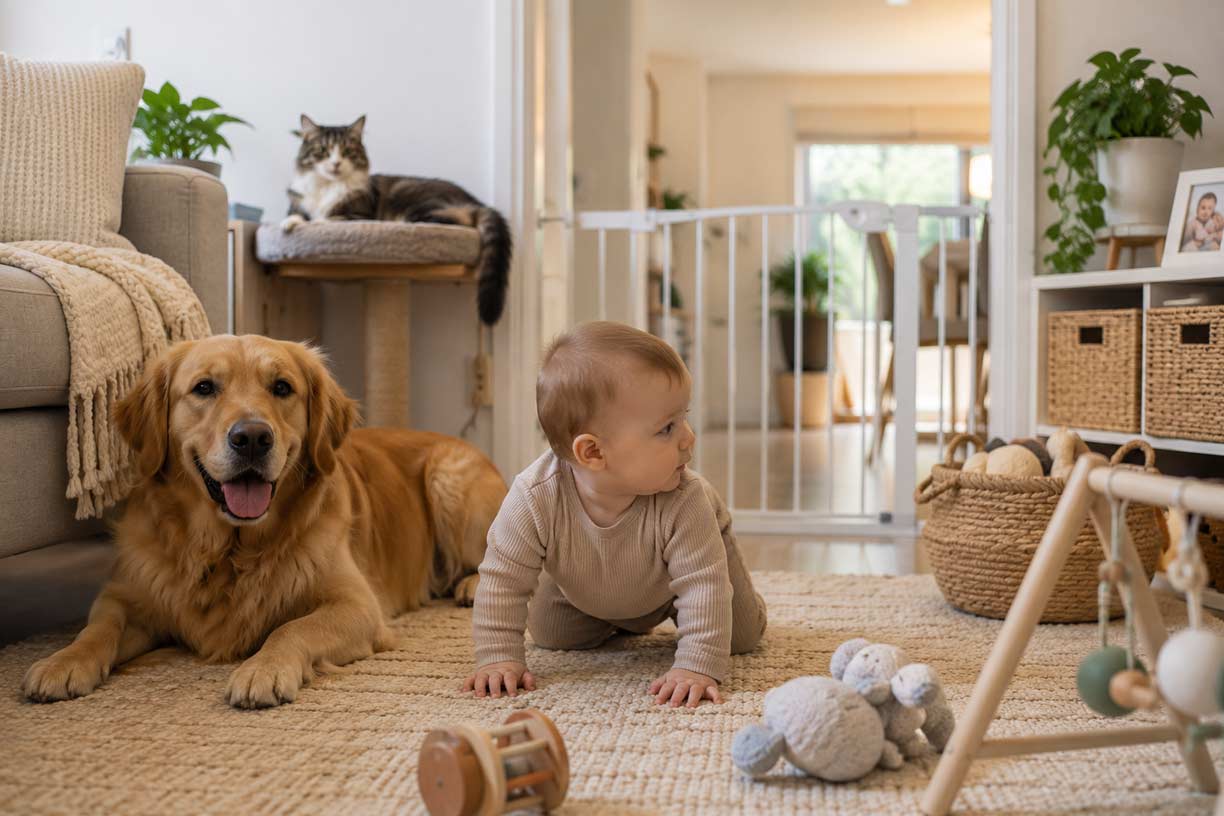
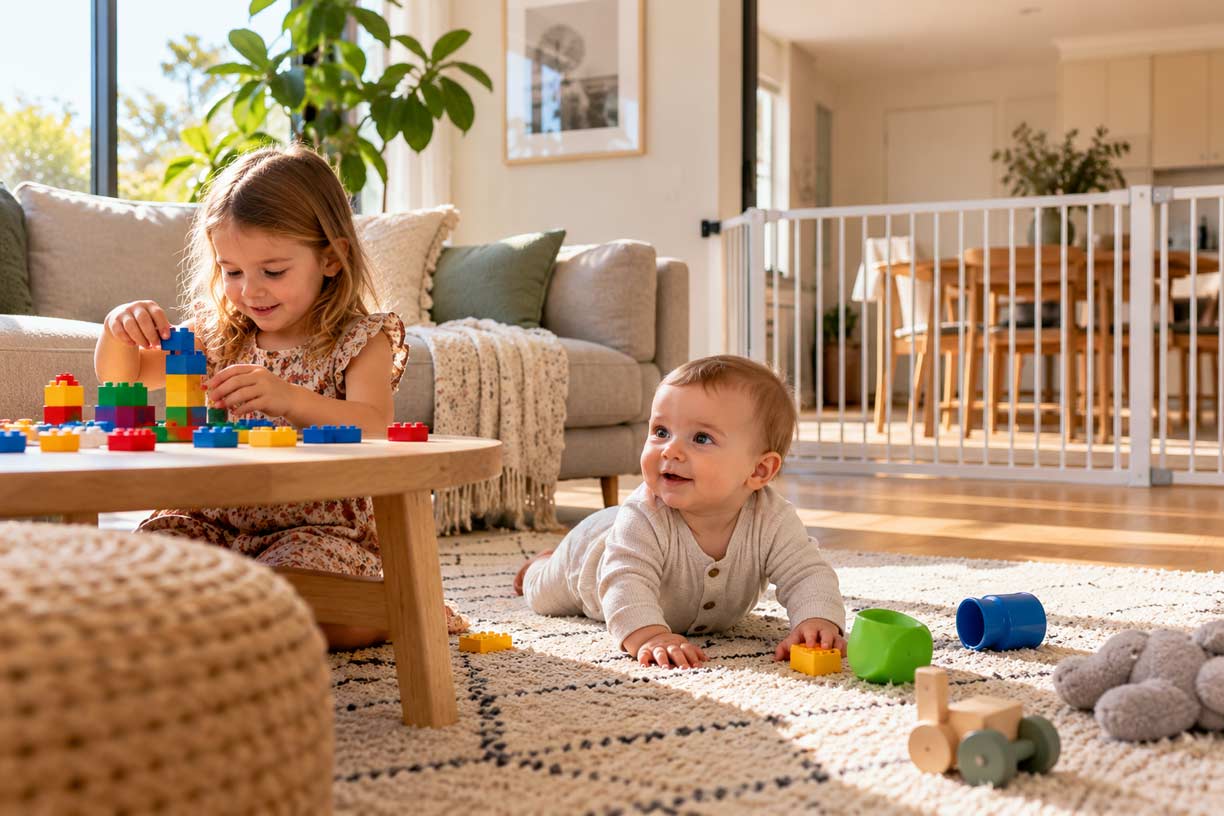
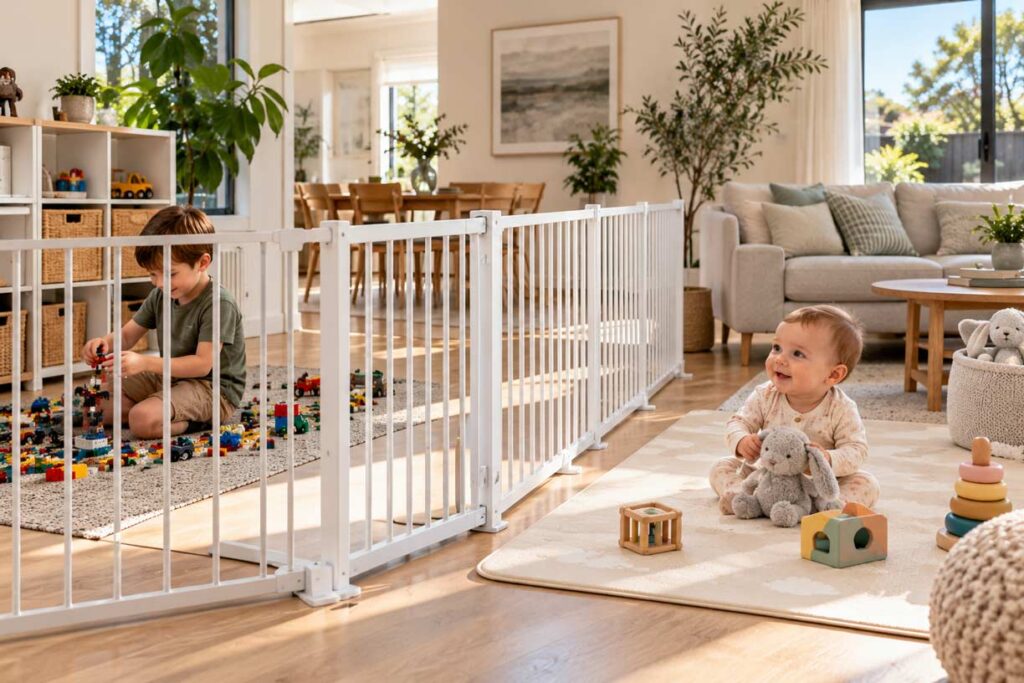
In a single-child home, gates usually block a hazard: the stairs, the kitchen or the laundry. In a multi-child home they do a second job. They create zones, so the older child can play with small-part toys in one area while the baby explores safely in another.
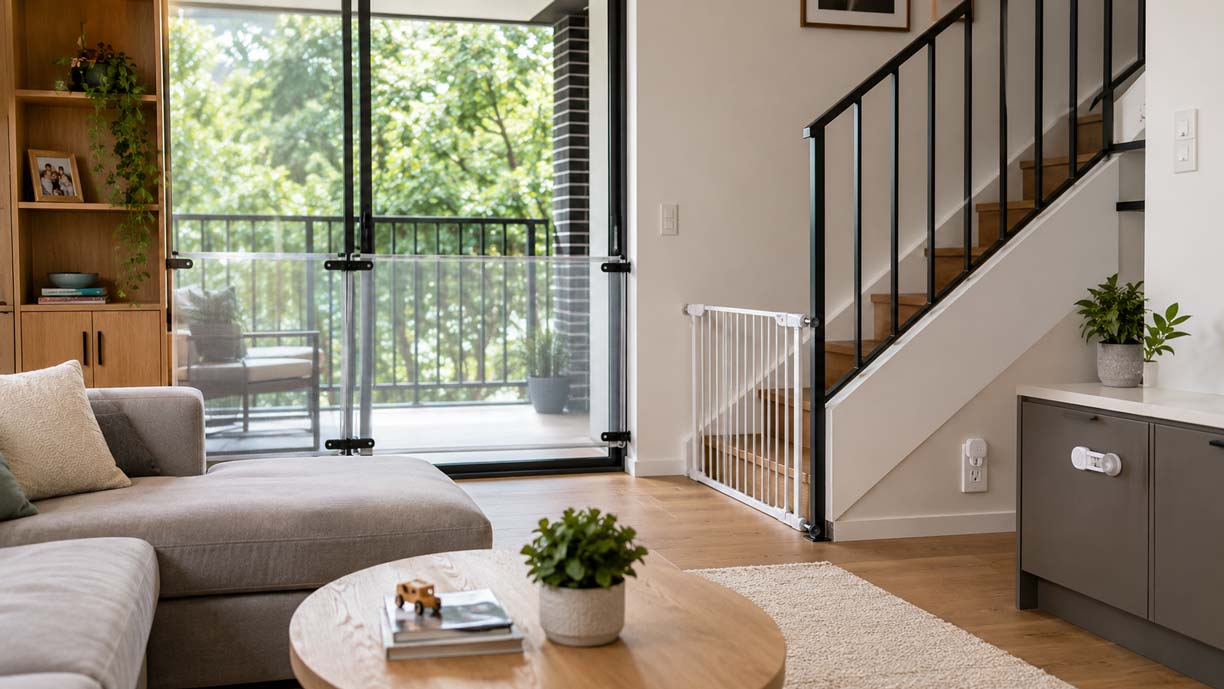
An open-plan living area can often be divided with a 3-in-1 baby gate for open-plan play zones, which can be configured to fit wide or irregular spaces. For doorways, a pressure-mounted baby gate that needs no drilling suits a playroom or hallway where the zone may shift as your children grow.
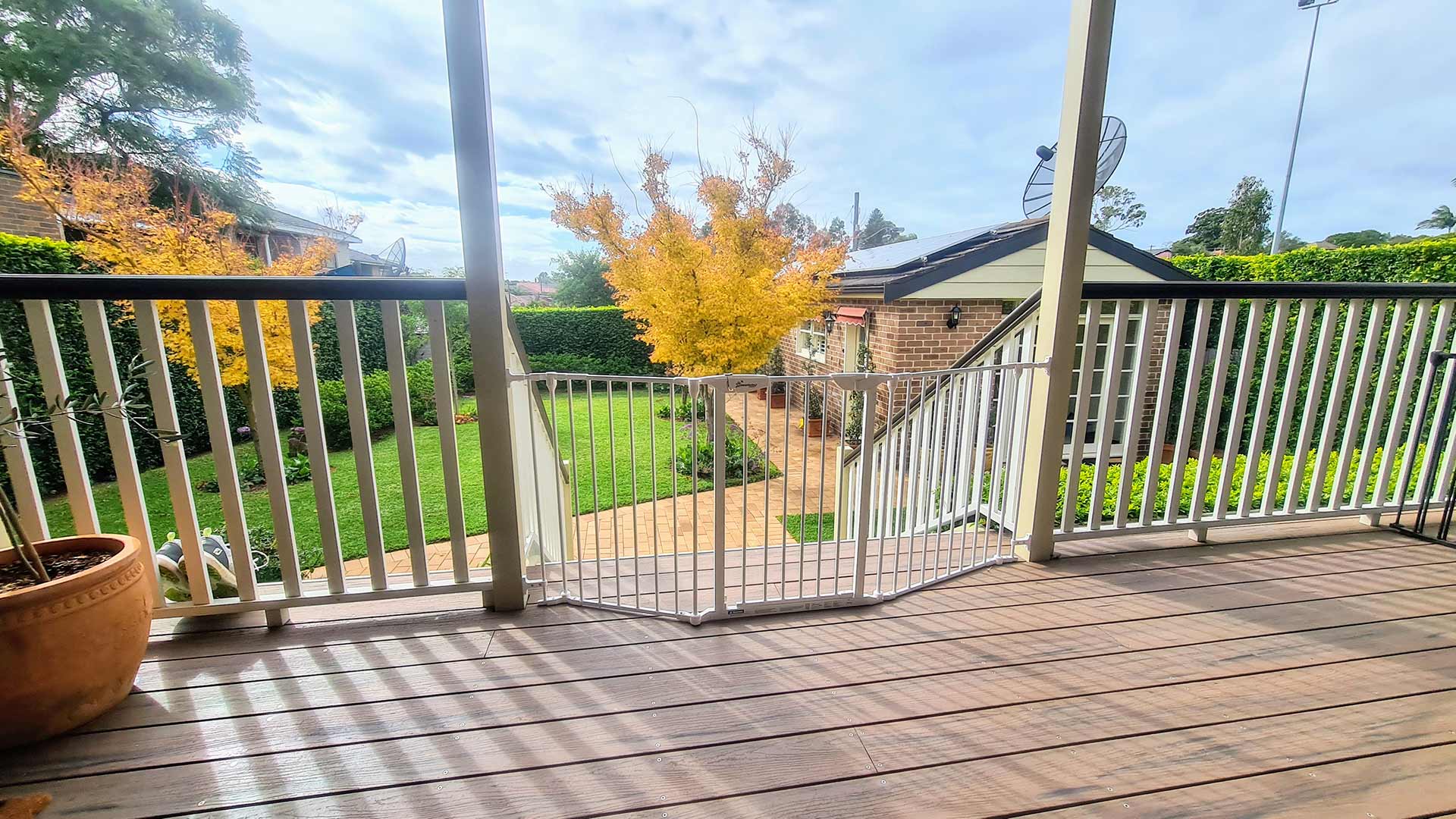
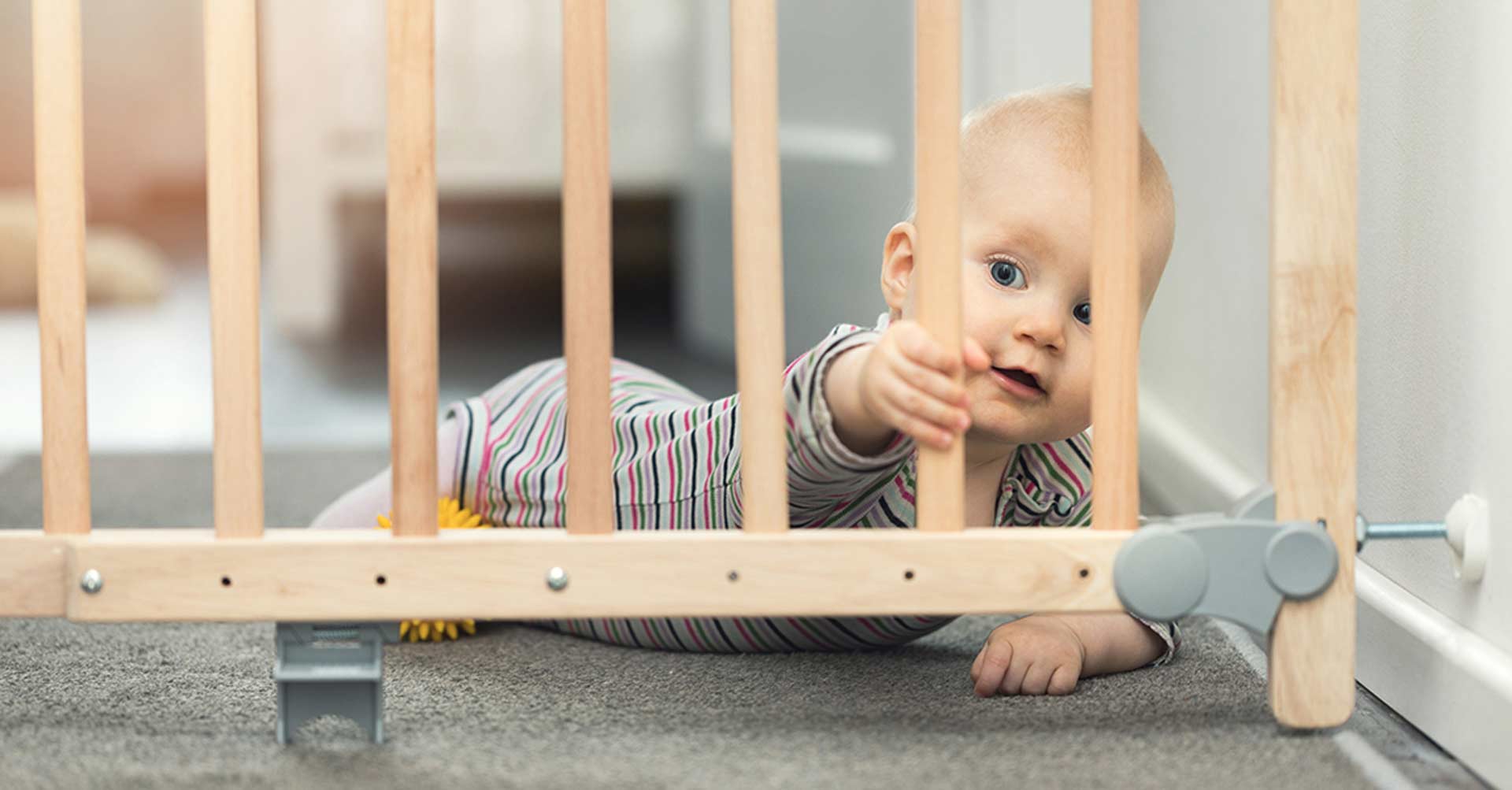
The catch is that older children can operate most gates, and they do not always close them behind them. Choose gates that self-close and latch automatically, and teach older siblings that the gate gets shut every single time. At the top of the stairs, a hardware-mounted gate is the only safe option, no matter who is using it.
Climbing, Copying and Furniture Tip-Overs
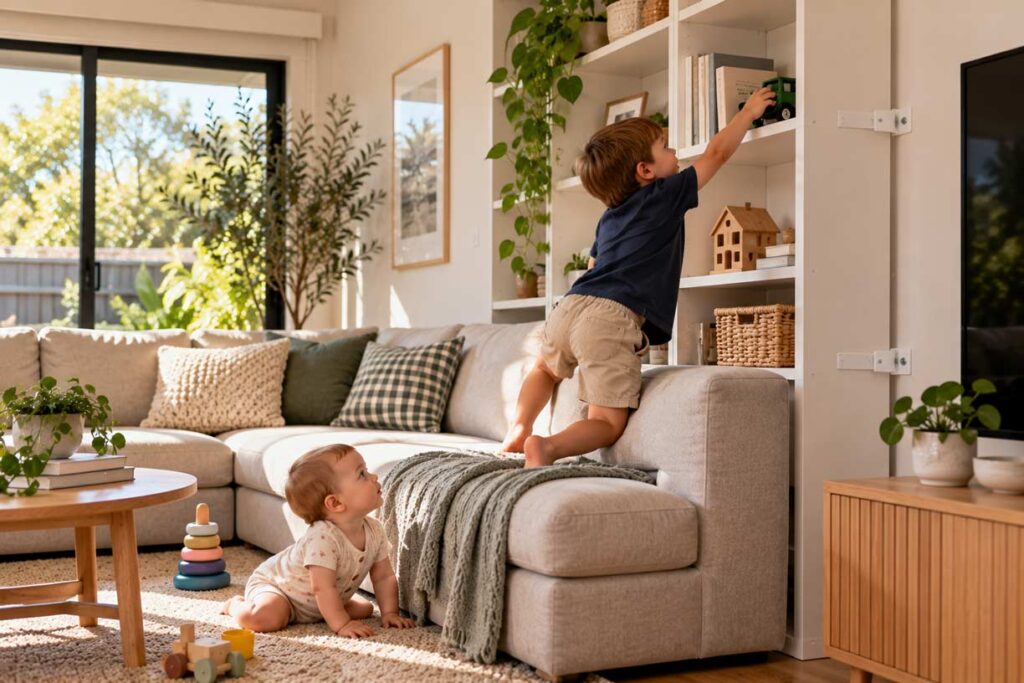
Babies learn by watching, and a younger sibling watches the older one constantly. If a big sister climbs onto the arm of the couch or uses open drawers as steps to reach a shelf, the baby will try the same thing long before they have the strength or balance for it.
That makes anchoring even more important in homes with more than one child. Chests of drawers, bookshelves, wardrobes and toy storage in an older child’s bedroom are prime climbing targets, and they are usually loaded with heavier items than a nursery. Professional furniture strap installation in Sydney anchors each piece into a stud or solid fixing point rather than plasterboard. Televisions need the same attention, especially when excited siblings crowd around a favourite show, and TV safety straps that prevent tip-overs stop a set from being pulled forward.
Doors, Cupboards and the Older Child Who Leaves Them Open
Older siblings are not being careless. They are simply at an age where closing doors and cupboards is not yet automatic. These are the habits that come up most often, and the simplest fix for each.
| Older child habit | Risk for the baby | Practical fix |
|---|---|---|
| Leaves their bedroom door open | Access to small toys, batteries and climbable furniture | A lever door lock on the bedroom door |
| Leaves the back or screen door open | Unsupervised access to the backyard or pool area | A self-closing gate at the transition point |
| Opens cupboards for snacks or craft supplies | Access to cleaning products, medicines or sharp items | Magnetic cupboard locks on hazard cupboards |
| Plays with small toys in the living area | Small parts left behind on the floor | Set tidy-up times and a separate small-part play zone |
A lever door lock for your older child’s bedroom keeps a determined crawler out without shutting your older child in, while magnetic cupboard locks stay invisible from the outside and only open with a magnetic key. Outdoor spaces bring their own challenges with older children, which we cover in our guide to what parents miss in outdoor baby proofing.
Getting Older Siblings on the Safety Team
Older children usually love to help, and giving them a clear role works far better than a long list of rules. Keep expectations simple and suited to their age:
- Close the gate and the back door every time
- Keep small toys in their room or at the table, not on the floor
- Tell an adult straight away if the baby has something in their mouth
- Never put toys, pillows or blankets in the baby’s cot
- Only pick up or carry the baby when an adult is right there
Praise them when they get it right. A preschooler who feels trusted is far more likely to remember the gate than one who has only been told off. Even the most helpful sibling, though, is never a substitute for adult supervision.
Baby Proofing With an Older Sibling in Sydney: One Walk-Through for the Whole Family
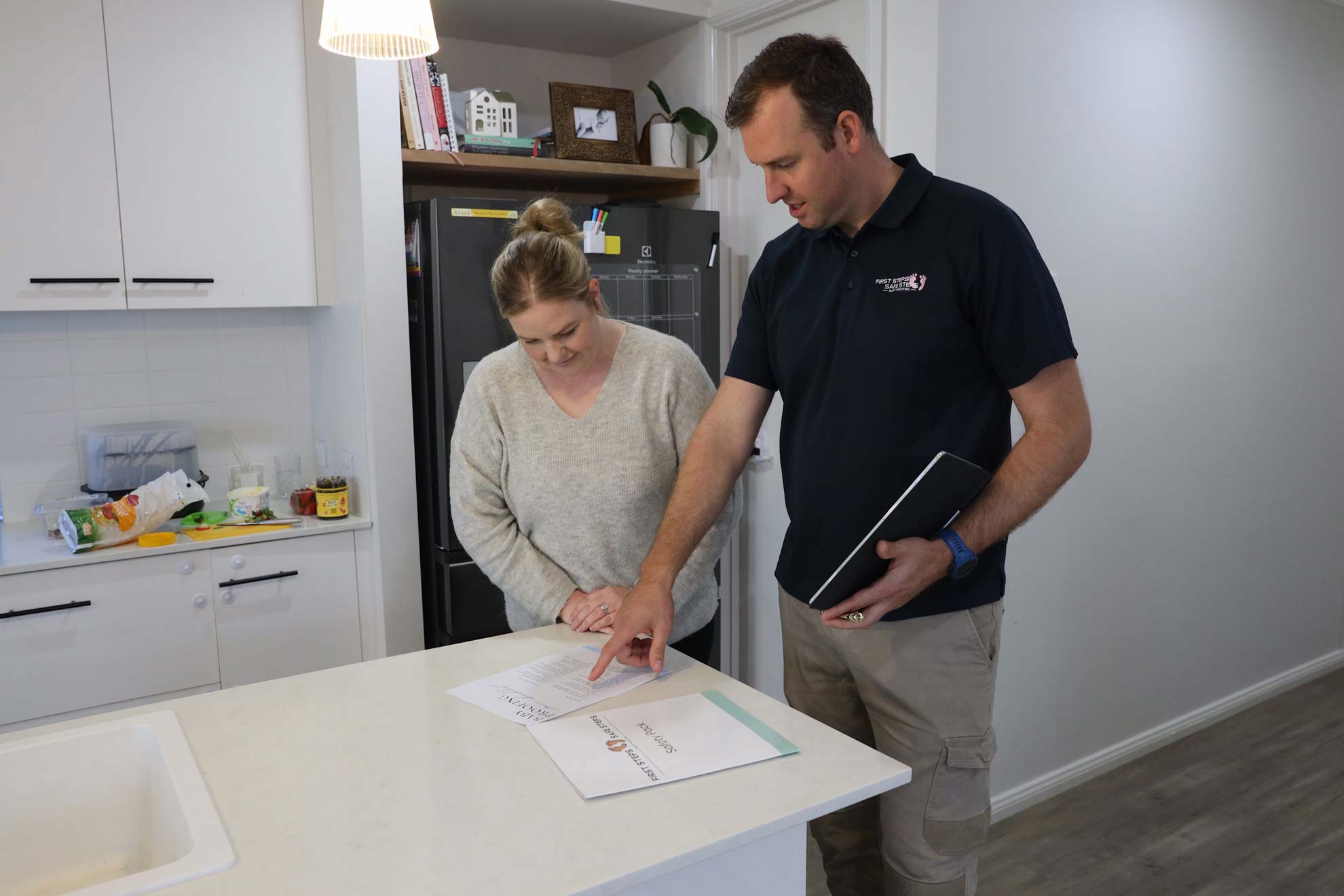
The simplest way to cover both timelines at once is a professional walk-through that looks at your home as it is now, with every child in it. Mitchell assesses the spaces your baby will reach, the areas your older child needs access to and the points where the two overlap, then installs what is needed in the same visit.
As DreamBaby’s Recommended Baby Safety Installer, a partner of Rescueblue and a 2025 INPAA Tried and True Service Award recipient, First Steps Safe Steps brings specialist child safety expertise to multi-child homes across Sydney, with same-week appointments available.
Book a safety consultation for your growing family or explore our full range of professional baby proofing services across Sydney.
FAQs: Baby Proofing With an Older Sibling
How do I keep my baby safe from my older child’s toys?
Store toys with small parts, button batteries or magnets in lidded containers up high or in the older child’s room, and keep a separate basket of baby-safe toys at floor level. A gated play zone lets older children enjoy small-part toys without the baby reaching them.
Do I need to baby proof again for my second baby?
Yes, in most homes. Safety measures are often relaxed or removed as a first child grows, and an older sibling adds new hazards such as small toys and open doors. A fresh assessment before your baby starts crawling catches what has changed.
When should I start baby proofing for a second baby?
Ideally from around five to six months, before your baby is mobile. With an older child already in the house, small toys and open doors are present from day one, so starting early matters even more than it did the first time.
What is the best baby gate when you have older children?
A gate that self-closes and latches automatically is the most reliable choice, as older children often forget to shut it. Hardware-mounted gates are essential at the top of stairs, while pressure-mounted or 3-in-1 gates work well for creating play zones.
How do you baby proof a playroom shared by a baby and a toddler?
Divide the room into zones, anchor all storage units to the wall, and keep small-part toys on high shelves or in lidded tubs. Low shelves should only hold baby-safe items, and a quick floor sweep before the baby plays catches anything left behind.
Can an older sibling be left alone with a baby?
No. Even a caring, responsible older child cannot be expected to spot every hazard or respond in an emergency. Older siblings can be wonderful helpers, but a baby should always have direct adult supervision.